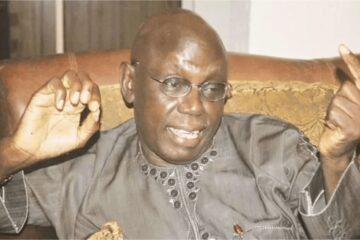
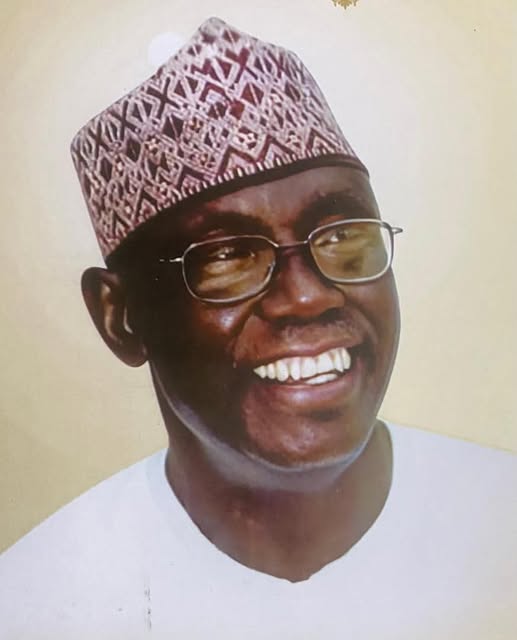
THE DEBATE AND DISCUSSION FORUM BRINGS YOU THE INTERVIEW HE GRANTED ON RADIO BENUE ANCHORED BY CHARLES IORNUMBE – THE THEN PRODUCER OF VIEWPOINT.
MR. AGBESE WAS 65 YRS OLD.
Dan Agbese,
Former Editor-In-Chief, Newswatch Magazine
Dan Agbese is a veteran journalist of international reckoning. He is former Editor-in-Chief of Newswatch; former Editor of the Nigerian Standard Jos, Plateau State; former Editor, New Nigeria in Kaduna and former General Manager, Radio Benue. In this interview, Mr. Agbese speaks on the creation of the Ministry of Niger Delta Affairs by the Federal Government to tackle militancy and the place of the media in the reportage of happenings in the region. Mr. Agbese also bares his mind on what constitutes ideal journalism practice in Nigeria. He speaks on his relationship with renowned journalists like the late Dele Giwa. The Ado born media guru tells the Anchor why his writings were critical and thorough in both military and democratic times. Read the excerpts below.
Iornumbe: Mr. Dan Agbese, it is a pleasure to host you on this programme.
Agbese: Thank you very much, indeed.
My name is Charles Iornumbe. Let me start on this note. Who is an ideal journalist?
Agbese: Well, I don’t think anybody has ever defined an ideal journalist. We can always talk about a successful journalist in his own right, because we don’t have objective criteria to decide who is an ideal journalist. But what one can say is that, the person who can approach the ideal journalist may be the person who is professionally committed to the ethics of the profession and upholds the integrity of the profession and does everything in an attempt to enhance the integrity and reputation of the profession of journalism.
Iornumbe: You have been in this profession for a number of years and the experience you have gained over the years is one that will enable you to assess journalism practice in Nigeria. We talk about the western media; we talk about media in the north and all that. So how would you lend your voice to this?
Agbese: Well, you see, how you rate journalism is based on the society in which the profession itself is practiced. And so you cannot rate journalism in the Nigerian society the same as you would in Britain or the United States of America, nor indeed would you rate the practice of journalism in the north the same way as you would in the south, because of cultural and religious differences and because of the need to protect cultural and religious interests. And so, what journalism does is to mirror in effect the society within which it is practiced. And so, if you move from the north to the south, if you practice your profession in the north or the so called core north, you will have a different experience because, the publication for which you work will have its own policy and that policy will determine what you can and cannot report and how you can or cannot report certain things. If you move down south, it is a different ball game all together. So, in other words even within the same country you cannot expect journalism to serve the same kind of religious and political interest the same way.
Iornumbe: Talking about the Niger-Delta problem which has calmed down for now due to federal government intervention – creating a ministry and putting somebody who is within that environment as minister to run that area and then of course the agreement signed by the militants and the federal government. Would you say that provides a source material for good journalism in Nigeria as it were?
Agbese: Well, I think it does, because, you see, all of us tend to look at the Niger-Delta problem the same way. I think there are several or many angles to that problem in the Niger-Delta.The first is to recognise the fact that the so called militants do not represent the collective interest of the Niger-Delta people. Maybe at the beginning there were some who were motivated to take up arms or to do what they were doing because they believed that there were certain interests they must protect, the interests of their people. But as time went on, whatever those interests were and whatever the method they chose to protect those interests were hijacked by other people who simply use such as ways of making quick money. I believe in the face of the crisis: is it going to be impossible to think more clearly and to act objectively? And so to that extent, I do commend the federal government for entering into the agreement because the guns have fallen silent for the time being.
But I think that there are more fundamental problems that must have to be approached because it doesn’t take someone who comes from that region to know that, that region which produces the country’s main source of revenue is also one of the most neglected regions in the country and so the problems are very fundamental. And from the time as far back as, I think 1958, the Wilik Commission set up by Her Majesty did look into the problem of the Niger-Delta that time and recommended the setting up of what later became UMPADEL and now you have NDC and the rest of it in order to tackle the specific and special problems, the peculiar problems of that region.
Iornumbe: Mr. Dan Agbese, we are looking at the place of the media in the Niger-Delta issue. Yes, for instance, we mentioned Niger-Delta because it happens to be one of the most volatile areas prone to kidnapping and so many other crimes being committed. Some people are of the opinion that the media didn’t help matters by way of over publicizing and glorifying the militants. In newspapers you see pictures of young men covering their faces and carrying guns, that there was no need for such journalism. Do you subscribe to this kind of thinking?
Agbese: Well, I have heard that criticism before and you can take that criticism to every aspect of our national life. There are those who believe that we are at the stage of developing journalism, what they call developmental journalism which requires or which stipulates their views. A reporter in this kind of situation always looks at what is positive rather than what is negative. But that is not journalism. That is not life. Life is both positive and negative. And it will be a failure on the part of journalism to ignore the negative aspect of societal life. The point I was trying to make in analyzing the problem of the Niger-Delta is that even as we report, we have always ignored the fundamental problems of the Niger-Delta. In other words, we are doing what I like to call journalism of the moment. That is to say, whatever grasps the headlines is what we go for and so if you have a group of young men taking up arms against their fatherland… First of all, you see that anybody who fights the government is regarded as an underdog. And it is one of the failings of journalism that it tends to side with the underdog at all times. So it is the same thing with Niger-Delta. What that does in effect is that it prevents you from doing serious journalism and looking into the issues and looking even into the situation of those who carry arms. And so we are reduced to looking at the surface instead of digging into the fundamental issues.
Iornumbe: In the first question, I dwelt on who you would perceive as an ideal journalist in this country or what would be an ideal journalism practice in this country. We are so much worried that the profession has become an all-comers affair. Are you equally worried or not?
Agbese: I am not worried about that. I am more worried about the fact that there is no tutelage system in the profession anymore. Today, a young man who leaves the university, whether he read journalism or any course is immaterial, he goes into journalism. After one year he finds a man who has enough money to spend and sets up a publication and makes him Editor-in-Chief or Editor. The people he is going to recruit are the same people who have the same level of experience which is actually no experience at all or very little experience and about the same age, the same experience and these are the people who are working under him. and nobody is in a position to direct the other. And therefore, what suffers is quality of editorial judgement. Journalism, as one of my colleagues used to say, is a market place and so anybody can go to the market. In other words, journalism is a meeting point, in fact, of all disciplines; we have doctors, pharmacists, engineers, historians, political scientists. The process through which someone can acquire experience on the job before he can take heavier editorial responsibilities, because it helps not only to broaden his outlay; it also helps in editorial judgement. That is a very critical thing in journalism, editorial judgement.
Iornumbe: Okay. Mr. Agbese, what is the reason for a journalist to move from one media house to another in the course of his life, using you as an example? Is it that you are looking for money that you haven’t got?
Agbese: Well, if I were looking for money, I wouldn’t be in journalism up till this time. I would have left a long time ago. I didn’t move to some of these publications as a result of looking for money. I was Editor of Nigerian Standard and when the civilians took over, I was the Editor of Nigerian when Benue State was part of what then was Benue-Plateau State. So, when Benue State was created in 1976, some of us remained there because Benue State didn’t have its own newspaper or news media. As time went on, when the country returned to civil rule, of course, the Plateau people wanted their own people. But luckily for me, the letter passed through Festus Shelleng, governor of the state that gave me a job as General Manager of Radio Benue.
But I left on the basis of the fact that I was brought home to serve Benue State. I was there for barely two years when the same governor very kindly appointed me as Director of Information as well as Special Adviser on Information. I was there when I was approached to go and edit the New Nigeria, because at the time I came to Radio Benue, I thought my journalism days were over and I was not going back to journalism. When I was the Director of Information, I was approached and Aper Aku was virtually blackmailed to release me because I didn’t want to go to the New Nigeria. I started my career in the New Nigeria and I thought I was not going back to the New Nigeria. So I didn’t move because I was looking for more money. In the end Aper Aku was persuaded to let me go and I was persuaded to go and edit New Nigeria. So I went to edit the New Nigeria, and so I was there until I think about April 1984, during the military regime. Now, the military returned to power in January that year and I was reassigned. In other words, I was removed as Editor of New Nigeria to be reassigned and then they didn’t have a job for me. They wanted me to go and write application to go to Daily Times and I said I was not going to write application to Daily Times. In any case, I was not going to take up another government job without being told why I was removed as Editor of New Nigeria. And so at this time three of my colleagues who were the co-founders of News Watch also had some problems where they were working at the National Concord, and so the four of us now decided to move out and set up our own publication and we thought that the News Magazine was something that hadn’t been tried before and we thought we could try our hands on it. In other words, Charles, I was not looking for money.
Iornumbe: Now, when you set up the News Watch, we realised that the first Editor-in-Chief was the late Dele Giwa of blessed memory. So many Nigerians have read most of his editorials, and they marveled and some Nigerians became inspired to join the profession. How has that dream been sustained?
Agbese: Well, you see, the thing is that News Watch was a collective thing and so the dream was a collective dream, the approach was a collective approach and whatever we did was done collectively. In any organization, you got to have leaders. I was actually at the beginning the Managing Director of News Watch and Dele the Editor-in-Chief. After some time, less than one year, I said to the Board, I don’t think it was necessary to have those positions, so I thought it was going to be better to at least collect the tools into one person. Moreover, I still wanted to be a journalist, you know. Being a Managing Director was an administrative job and I didn’t want to do it at the time. I wanted to go back into reporting and to give the best that I could to reporting. In other words, whatever dreams we have, whatever plans we had were sustained as of this moment in News Watch.
Dele Giwa was first Editor-in-Chief, so his approach in the job would be, you know, unique to him as mine would be unique to me. But we have always kept faith with one thing, that we have set up News Watch not merely as a publication but as a public institution. We wanted to do more than simply publishing, wanted to affect the society in which we live. And the desire had always been that we are going to do the best in journalism. And so, today, when we look back around and we see, a whole lot of young people have come together to set up their own publications because they saw that we succeeded and there are a whole lot of people who couldn’t have done it. We were the first to try it, the first group of professionals to try it in this country and we have remained together for twenty-five years or twenty-six years. I thought it was beyond what anybody thought it was going to be and so, in other words, nothing has since Dele’s unfortunate death, hindered our corporate existence?
Iornumbe: Mr. Agbese, the assasination of the late Dele Giwa as described by five writers including Professor Niyi Osundere, Professor Adebayo Williams, Yakubu Mohammed Onomo, Osifo Whisky, Ray Ekpo and yourself in News Watch’s best publication was an equivalent of the assasination of journalism. How would you expand on this further?
Agbese: You see, a profession cannot die because of the death of one man or the death of several people. What we did in the articles you are referring to was to celebrate our fallen colleague, to say this was the kind of man he was; this was the kind of belief he had and this was how he approached his job. In other words, what we were trying to do was to hold the mirror to him so that younger people can look at him from five different perspectives, as you enumerated and I am sure there are other perspectives, but at least five of those perspectives are different from one another. And so anybody, people who didn’t know him could have some idea of what he was and what kind of journalist he was, what kind of person he was from reading those five different perspectives. In other words, journalism didn’t die with him.
Iornumbe: Will it be right for somebody to also observe that his death ignited or compelled litreary outpouring that was described as unprecedented in the history of Nigeria?
Agbese: But you see, we have to look at the fact that he was the first person to be killed through a novelty – the parcel bomb. People have been killed in this country before but nobody has been killed through a parcel bomb, and he was the first to be killed that way. Secondly, he was the first journalist to be so killed in this country. So, you can see at least, if you put those two things together you could see that, and also he was a young man, and he was also a popular writer then. It was Daily Times and then the Sunday Concord which he edited and which he also wrote a column. And so if you put all that together, you see his death was not just a shock to the country, it was a shock to the world because of the novelty of the death, the instrument of death and the time it happened and because of the suspicion that it was the handiwork of government. You put all those things together, you could see that his death was a unique national experience, if you could call it that way.
Iornumbe: Anybody who has been following your articles over time will notice that you are very critical about issues both in military and civilian governments in this country. In one of the essays in News Watch titled ‘Distress Signals’, what message were you trying to put across?
Agbese: It has to do with world population explosion. At a time, there was a spirited campaign for people to limit the size of their families to manageable level because it was feared that the resources of the world would not, if the population keeps expanding at the rate it was, the resources could not sustain the population explosion. And so I think what I did was a very, was a satire article actually, looking at the problems of population explosion and the need for people to have situations where some countries are under populated and I put the two together and did the satire on the population explosion.
Iornumbe: Now in another titled ‘The Political Grain Killer’, you condemned the massive importation of rice during the Shagari administration and that was military government and you were so blunt. How were you able to do this?
Agbese: It was a simple thing, actually. Because you see, during the civilian regime, suddenly, the politicians, and the business compadores had elevated rice as a staple diet in this country and so there was massive importation of rice by all the states of the federation including the federal government and part of the congestion at the port had to do with the rice importation. I remember here in Benue, quite a few politicians who went into the business of importing rice made a whole lot of money. And I thought that we produce enough rice in this country. First of all, rice is not a staple diet. At least at that time, it wasn’t a staple diet. In other words, it was not the kind of food you will find on the table of any average person. When I was growing up, we ate rice only during Christmas. And for a whole lot of families they were still eating rice only on Sunday, so it was not a staple diet. But it became a major thing in the country because there was money to be made from it. They were making a whole lot of money. And because they were doing that, we were enriching the rice farmers in Thailand, Spain, the United States of America and impoverishing and in fact destroying our rice farmers here in Benue State, in what is now Ebonyi, Abakiliki area in Kebbi as well as Bauchi and few other rice producing areas. So I think at the time this article was written, there was an investigation by the military regime into rice importation and it was important to draw the line to let them know that they shouldn’t go back importing rice. If they want to cause rice revolution in this country, it is not by importing rice. It is by cultivating and encouraging the massive production of rice locally.
Iornumbe: You are quoted to have said Nigeria’s past is what constitutes her problem. What was in your mind?
Agbese: You see, whatever problem you don’t deal with today, tomorrow, today will be the past. In our national life too, whatever problem we don’t tackle today will be a major problem tomorrow. So, if we had dealt with some of the problems we had in the past honestly, objectively, seriously, the problems would not have caught up with us today. And so the past is always the problem. If you don’t do what you are supposed to do and you think that you are going to leave the past behind, the past will always follow you like a shadow.
Iornumbe: How does it feel? I believe you may have passed through good times, odd times in this journalism profession in both military and civilian administrations. What has been the experience?
Agbese: Well, it has been, what shall I say, a very interesting experience, I must say. If I didn’t find it interesting, I wouldn’t still be here, I will be doing something else, probably would be a politician or a contractor, but I like it. I like the experience. I have been detained quite a few times. I tell people that I am a graduate of Ikoyi prisons. I spent two weeks in Ikoyi prisons. I spent a week in SSS in 15 Awolowo Road. I have been to detention centres and the rest of it, just because I was trying to do my job. The interesting thing is that I have never been convicted, you know, in the course of all these harassments which means that in the end the authorities realised that I was trying to do no more than my job, to serve my country the way I can and that I could. And whether they like it or not I had a contribution to make and so I had to stick to it to make my contribution. And so I am grateful to God that I had such experiences I had. As a matter of fact, I began my journalism career during the military regime. I didn’t have problems during that period most probably because I was a junior staff, I didn’t have the kind of problems that I have had with News Watch or since we founded News Watch. But you see, interestingly, I found that even the civilians, if the military governor didn’t like what you wrote, he could detain you and let you go after some time or something like that. If a civilian governor didn’t like what you wrote, he will act in a way that you will not know. If you work with a government publication as I did, you would suddenly find yourself without a job, if nobody could defend your integrity. And so in both forms of administration, you have the ups and downs. But I know, I am sure that you may know, you yourself may know this. Journalism thrives more in the period of crises. What kills journalism, what destroys journalism is a benign neglect. If you work in a situation where whatever you write doesn’t excite anybody in public office, nobody says anything, it is like you are talking to the deaf. In my own experience, it was more exciting working in the military regime because there were laws, you have to skate around the laws to survive and it was very exciting because they had to find fresh ways of saying the same thing. Instead of saying the government was wrong, you have to find more creative way of saying the government was wrong without saying the government was wrong.
Iornumbe: Now, I would like to read a small portion of the September 14th Edition of News Watch, the editorial. You said, “I am sure that CBN Governor Sanusi Lamido Sanusi will be unfazed by the controversy swerving around his frankly honest attempt to perform his statutory duty in a manner beneficial to this ravaged country and its ravaged citizens”. The word “ravaged country, ravaged citizens”. Are you not found castigating your country?
Agbese: Yes, is it not true that the country is ravaged? Is it not true that the people are ravaged?
Iornumbe: So, you still belong to this country?
Agbese: Yeah, why, why not? I mean, you see, if I say my country is not an ideal country, I am not saying to myself, so why should I be in this country? I am saying I am drawing attention to the fact that this country is not what all of us think it should be. Now, ravaged country, you can see the level to which it has been ravaged. Take one simple example. Why is it impossible for us to have light? If you go into the budget you see a whole lot of it. You see how much money is being voted for NEPA or whatever and to set up independent power supply and all the rest of it. Nearly 50 years after independence, this country cannot have light. We are talking about generating 60,000 megawatt of power by next month. No country in Africa is talking about that, they have gone beyond that. Is it not ravaged? If you have a country which, you have a democracy and people are frankly and totally disenfranchised by the politicians themselves, is it not ravaged? You talk about a country whose Minister of Education, with a straight face, will say to you that four-fifth (4/5) of all our graduates are unemployable. In other words, out of every hundred (100) graduates, eighty (80) of them are unemployable, is it not a ravaged country? The educational system is being ravaged, it is being destroyed; is that something you have to be proud of? Does it take anything from you to say so? It doesn’t take anything from you to say so. It doesn’t say to me because I say so, therefore I am not qualified to continue to live in this country. I say so because I need to bring it to the attention of people who are ruling me to understand that this country is not what it should be. And that they have a duty to help this country and move this country forward in a way that all of us will be proud of. In this country, you talk about any kind of crime: kidnapping is becoming a big business in this country. Where is it practised in any part of Africa. Armed robbery, where do you have it any part of Africa? Citizens are ravaged, the country is ravaged and I don’t have any apologies for that.
Iornumbe: What is the way forward?
Agbese: The way forward is for our leaders to understand and try to make amends to what is happening. Because, if they continue the way they are doing, then the country is going to be worse off tomorrow than it is now. Today, look at the result of secondary school examination. One million, three hundred and something thousand children wrote examination, only one quarter of them scored the minimum of credits in English and Mathematics and three other subjects and therefore are initially qualified to go to the university. Is that the kind of country you are talking about? And NECO was even worse. Ten per cent of them passed out of one point something million students who sat for the examination. If we are not trying to clean up the system, you are talking about fighting corruption and we devote all our resources trying to fight corruption and corruption is going on, nobody is tackling it the way it should be tackled because the system itself is corrupt. If the system is corrupt then, it is easier for people to steal money. If the system itself is clean, then it is impossible for people to steal money the way that they steal money. So the first thing to do even in fighting corruption is to strengthen the system, clean up the system, let the system be protected because that’s what other countries do. If the system is protected, it is impossible for people to steal or always steal under any disguise. It will be difficult for them to steal at the level that they steal in this country. So that is what I am saying. I don’t have any apologies for that.
Iornumbe: Still drawing from that particular editorial, you were trying to say something about Sanusi, maybe you will throw more light or are you telling Nigerians that you are not comfortable with the appointment of this man as a Central Bank Governor or something is going to create problem for him?
Agbese: You see, what you are referring to was actually my column. In that column, I was quite shocked about the fact that people, particularly from the southern part of the country, were reading the actions and saying that what he was doing was trying to undo what Charles Soludo his predecessor did in office. According to them, during the consolidation, the northerners were placed at a disadvantaged point and so the north did not have a strong northern presence in the banking industry. Today, what Sanusi is doing is to undo what he did, in order that he can bring the north back into the banking system. I found that shocking and I juxtaposed that with what is going on at the federal level where the Head of Service of the federation had also introduced this system which says that you cannot be a permanent secretary for more than eight ( years. After eight years you must retire. And so when that policy was implemented, more northerners than southerners were affected at the level. Northerners now say, he was acting against the interest of the north and I put the two together. Here are policies that these people are implementing to the best of their abilities and people are reading different meanings into them. And so what Sanusi was doing, he was trying to carry out the Northern Agenda and what Orosanya is doing is to carry out the so called Southern Agenda against the north.
Iornumbe: Mr. Dan Agbese, your writings appear to have so much of figurative language, so much that one finds it difficult to draw a line between a journalist and a creative writer. Why is it so?
Agbese: Well, a creative writer is a fiction writer. I am not a fiction writer. If I do some predictions in my column and they come to pass, you know, I say thank God for that. I have no gift of prophecy and all I try to do is to express my views on certain issues in the coutry. And if I have people who support this view, it is all well and good and if I have people who oppose them, it is all well and good because their opposition will also open my eyes to other aspects of my own views that I haven’t taken into consideration.
Iornumbe: May we know the source of your wisdom?
Agbese: Thank you very much for talking about wisdom. I don’t think I possess any kind of wisdom. I am just a regular guy trying to do his job as a journalist the best way that I can. But you must also know that over the years, I mean, that you are bound to acquire certain experience, certain levels of experience, because of your interaction, because of your exposure, because of your reading and all these will come into play when you are expressing your views about certain issues and I suppose that is what is happening in my own case. When you talk about figurative expression, my own style of writing is normally satire and I enjoy satire. But I know it is a double edged sword, because some people can misinterpret it and some will understand it and some will misinterpret it and attack you because they don’t understand what you are talking about. But one of my most pleasant experiences with that system of writing was that I was once commended by the federal government for supporting its policy while actually I disagreed entirely with the policy.
Iornumbe: Why?
Agbese: Well, because they didn’t understand it, they took it litreally that I was supporting them but I wasn’t. That is the good and bad of satire.
Iornumbe: You were wrongly being commended or something.
Agbese: I don’t think I was wrongly being commended. I was commended for what I didn’t deserve to be commended for.
Iornumbe: So you have to put it correct?
Agbese: No, I didn’t have to.
Iornumbe: So what makes you fulfiled?
Agbese: You see at this stage, I am a trained in the field of journalism, so when young people come near me, my joy is to try to train them particularly in the areas of news judgement because that is very critical. And in the course of it, I have published two journalism books that are recommended, thank God. Text books in schools of journalism, in quite a good number of schools of journalism in the universities offering journalism, including Benue State University. That is the role that I am playing now and I feel quite fulfiled by it and so the more of these young people that I try to train, the more pleased I am with what I decided to do, to stick to the field of journalism. I am quite pleased about that and so I am fulfiled also by the fact that I have devoted, as I had promised myself that I would do, the rest of my life to journalism. I was not going to jump from one place to another; I was going to stick to it. If I was not going to make it, so be it. So I am fulfiled by that fact.
Iornumbe: You are already a successful journalist in this country, if the federal government at a point commended you for a column. I think its great isn’t it?
Agbese: I think so, I think it is great [laughs].
Iornumbe: Aren’t you are fulfiled?
Agbese: Yes, I am fulfiled.
Iornumbe: People of your age, you are 65.
Agbese: Yes.
Iornumbe: And most of these people who have come of age like to go into politics. Are you not thinking about that?
Agbese: No, I am not because you see, it seems to me that there are two major industries in this country today. Yes. One is politics, the other is religion, and I am not cut out for either of the two. I am quite satisfied being a journalist and I’ll be a journalist for the rest of my life. And I retired as a journalist; that is good enough. I didn’t have to be a politician to make contributions to the development of my country and I don’t think anybody has to go there because, people go there essentially because it is the major industry in the country and that means, it is the quickest way to make money. That is all. Most of them are not motivated by public service, they are motivated by selfish interest and I think that for me, that is a downer and not something that I would want myself to be. I am quite satisfied being a journalist. I am quite satisfied with the contributions I am making to national development in my own small way and I can’t ask for anything more. So I am not going to politics.
Iornumbe: You are giving us the assurance too that you will not leave News Watch for another organization?
Agbese: Where am I going to? News Watch is my company. As part of the founders or owners of the company, where am I going to? Is there anybody who is going to employ me? Nobody is going to employ me. I am totally unemployable now. You know, I can’t be employed by anybody (laughs). So where would I go? I can’t go anywhere else, because you see, there are people, there are young people in News Watch today who are there because we are there, and if you leave then, of course, you disappoint their expectations. They are there because they want to come and learn and you must be there to give them the opportunity to come and learn so that they can go out and fulfiled themselves as well. If I look around today, I see that in almost every publication, as well as in the electronic media, there are people who have looked up to me in one way or the other. I don’t think anybody can be as fulfiled as I am in that respect. In other words, I meet young people, a lot of whom are in schools of journalism. They say to me, I am there because I was inspired by what you write and I want to be a great journalist as well. I happen to be there as a grandfather of journalism, I can look forward to the time when I can sit by the fire side with all these children and grand children.
Iornumbe: So we understand you have a new publication ‘Nigeria, their Nigeria’?
Agbese: Yes.
Iornumbe: So what about it?
Agbese: Well, it is a book about Nigeria (laughs). The title comes from the fact that in this country, when things are going well with you, you say it is my Nigeria, our Nigeria. When things are not going well with you, you say na dem Nigeria, it is their Nigeria, na dem. That is how I got the title of the book. I derived the title of the book from there. What I tried to do was to ask, “Why are we the way we are?” That is because in every respect we are totally a unique nation. The people of this country are totally unique. The things they do to themselves, things they do to one another, there are not nationals of other countries that do those things, you know, so I tried to find out why we are the way we are. Why do we behave the way we behave? Why do we do things the way we do? And my very first chapter has to do with what I call the importance of being important because in this country, being important is very important.
Iornumbe: How could one be important?
Agbese: Well, you can see, the important people are people who aspire to be important. If you go to the road now, you will see the important people. The people who drive big cars feel that the road is meant for them and those who drive small cars and the Bilakaja and the rest of them should give them way. You go to public functions, those people who wear Agbada and the Babarigas and all the rest of it and who will often come late so that they can be recognised as coming late and the rest of it. So, you go to a function and the MC spends the next 20 minutes recognizing the important dignitaries because they need to be recognised, they are important people. It is important in the society. Then when I went back to look at our history, our national history, politics and all the rest of it, so it is a book I enjoyed writing. I have received also favourable comments about it from those who have read it.
Iornumbe: So, when is it coming out?
Agbese: It is out already; it is in circulation. It is on sale here in Makurdi.
Iornumbe: That is interesting. Now, a lot of young people, not just young people, people generally will look up to you as a role model, because in Nigeria today, like you said, people are making it in politics, others are making it through religion, establishment of churches and all that. Do you have a special word for such people?
Agbese: Let me just say that I am grateful to those who find me as a role model. I always say to them as one American actor said when he won the OSCAR and the press said he was an overnight success. They wrote it and said it was an overnight success. And he said it had taken him 25 years to earn the OSCAR and that is not overnight by any stretch of imagination. So the young people must be prepared also for the long haul. If there are easy ways to make money, journalism is not one of them and those who come in and try to use their identity cards as meal tickets are bringing disrepute to the profession. They have to be clean about it and to protect their own integrity and the integrity of the profession.
Iornumbe: Now, Nigerians are so obsessed with one-man business. I give you one example; Guiness today is successful because it has multiple partnerships. If one man drops dead today, another one continues with the signature on all its documents. What is going to be responsible for the continuity of News Watch?
Agbese: We have a succession plan so there will be no interruptions in sustaining the company. People will be there who will be sustaining the company. As I say, our objectives should be an institution. So that institution has to be maintained and for it to be maintained you must have a plan of succession, people who will carry on when you are no longer there, because we don’t expect to be there forever.
Iornumbe: You have a rich resume as Editor of the New Nigeria, Editor of Nigerian Standard, General Manager of Radio Benue and now Editor-in-Chief and co-founder of the News Watch Magazine. You equally have a tall experience in the field of journalism. What does it take to be all these?
Agbese: I suppose someone says it takes luck maybe, it takes blessings of God maybe, but I say it takes hard work. I have never been fortunate to have a godfather or a godmother for that matter. I have slogged my way through life. I have worked hard for everything that I have been able to do and I will continue that way because it is the only way that I know. If I am not recognised, too bad; if I am recognised, it is ok. I find fulfilment in what I do rather than in the applause that may come or may not come. And so I have been lucky to have been given opportunities to serve in various capacities and I thank those who gave me the opportunity to do so and I will always remain grateful to them. If there were failings on my part in any of these assignments, it is only human that those failings should always occur and I don’t have to apologise for them and I only say to them that my successes in these assignments must have been greater than the failings.
Iornumbe: The name, Dan Agbese, is synonymous with News Watch; it is synonymous with all these organizations that I have already mentioned on this programme. Is there anything you would like to tell Benue people about yourself that they haven’t known? Your background, your educational qualifications, because somebody will say if Dan Agbese writes so well, does he have a PhD? Is he a professor? Must one get to this level before one writes beautifully like this?
Agbese: Thank you very much Charles, I am not a professor. I trained initially as primary school teacher at Government Teachers College in Keffi. After that, I taught about three years and I went into journalism after about six months as a Library Assistant with Institute of Administration, Ahmadu Bello University and I went to New Nigeria where I started my career. I studied journalism at the University of Lagos and also at the Colombia University, Din, New York. Those are the two institutions where I studied journalism. When you were talking about fulfilment, there was one thing I forgot to say, that my first daughter, my first child also studied Mass Communication at the University in Lowa. She is now a Professor of Journalism at a university in the United States of America. So that is one of my personal fulfilments in life, that my first child will take after me. But instead of practicing it she decided to go and teach the American kids how to be journalists. And she earned her Doctorate, the year that I had not even in my own way earned my first degree (laughs).
Iornumbe: Interesting. We wish we had enough time to interact with you more and more but our time has expired. We want to sincerely thank you very much for driving all the way from Lagos to participate in this edition of ViewPoint. Our prayer is that at 65 years, God should take you to where you want to be.
Agbese: Thank you very much for the opportunity of being here in my former station.